
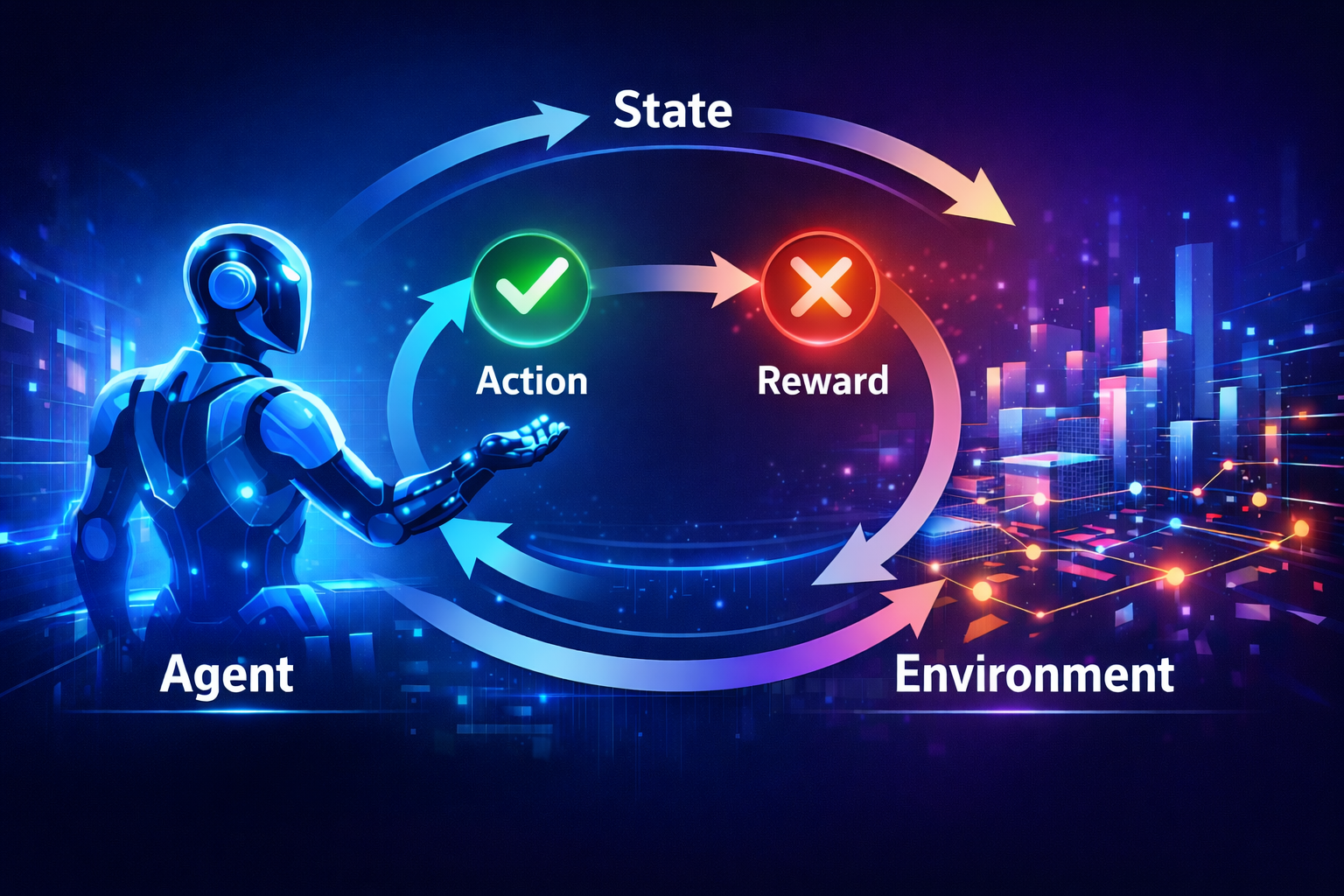
What Is Reinforcement Learning?
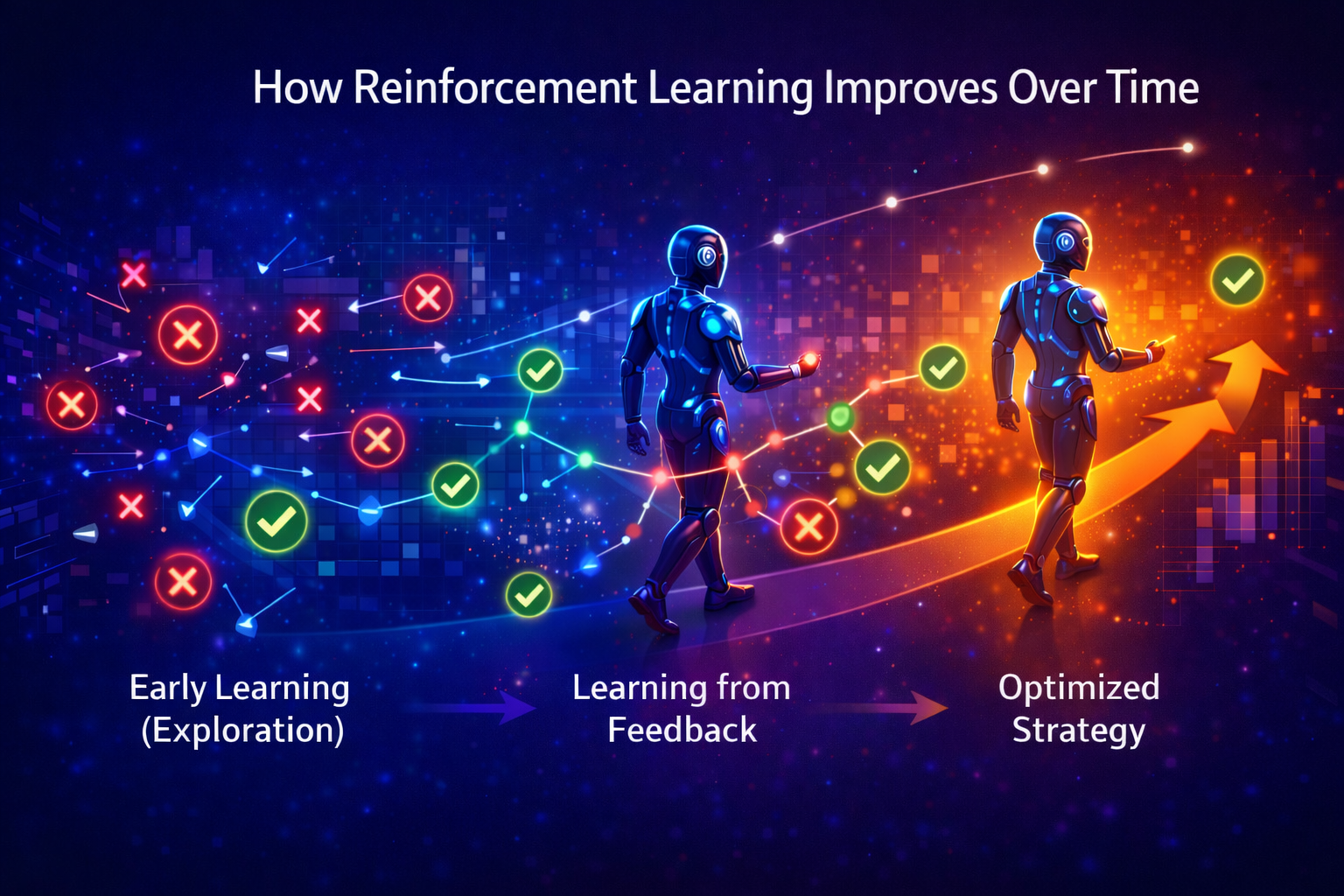
Reinforcement Learning (RL) is one of the core types of machine learning, alongside supervised and unsupervised learning. Unlike those approaches, RL focuses on learning through experience.
Instead of being told the correct answer, an RL system learns by:
- Trying different actions
- Observing the outcomes
- Adjusting behavior based on rewards or penalties
Think of it like training a dog:
- Good behavior → treat (reward)
- Bad behavior → no treat (penalty)
Over time, the dog learns what actions lead to the best outcomes.
👉 For a broader overview, see: Machine Learning Explained
👉 To compare approaches, see: Types of Machine Learning
Reinforcement Learning is a type of machine learning where an agent learns by interacting with an environment, receiving rewards or penalties, and improving its decisions over time to maximize long-term success.
How Reinforcement Learning Works (Step-by-Step)
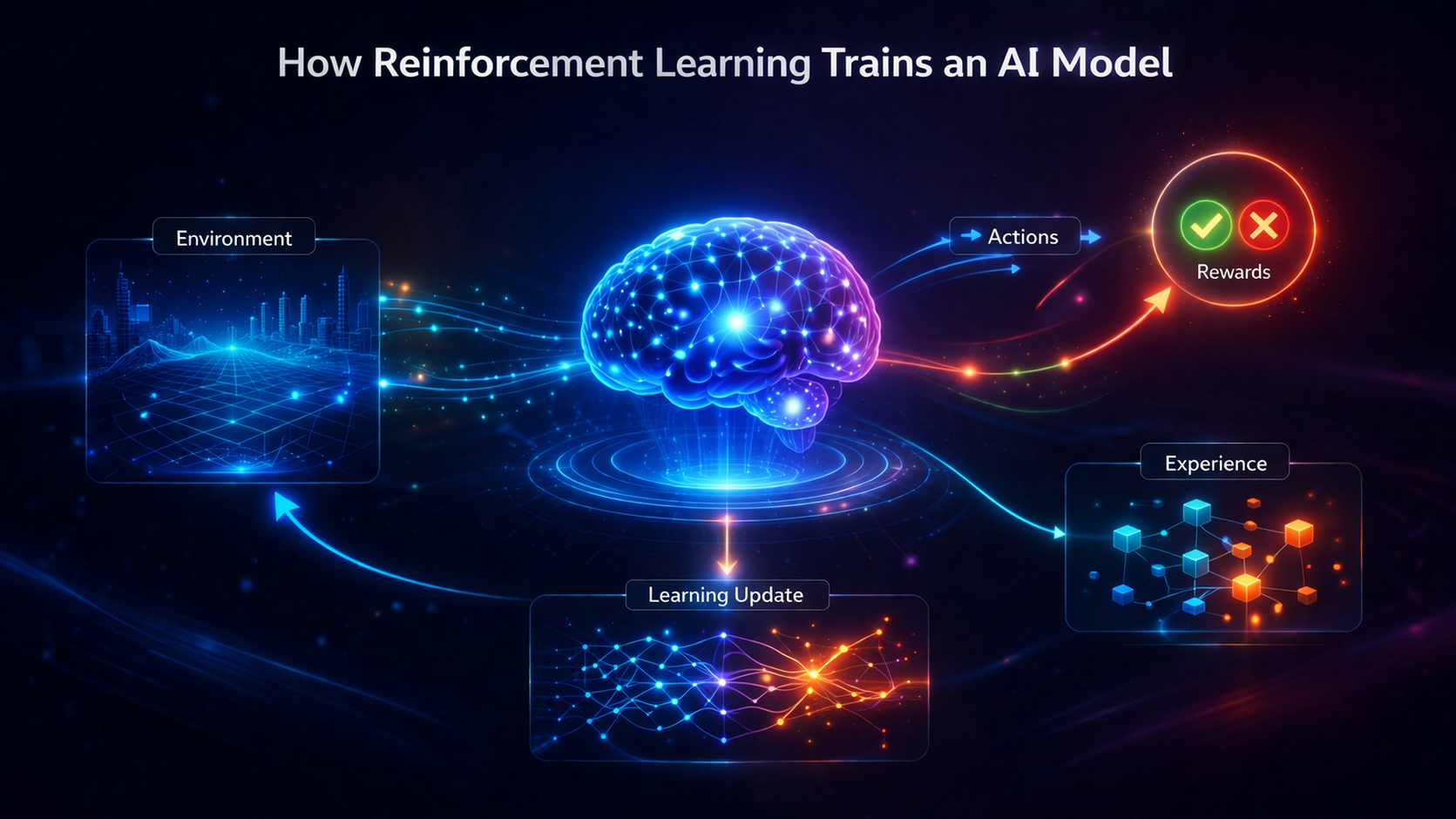
RL follows a continuous loop of interaction between an agent and its environment.
Step 1: The Agent Takes an Action
The agent (the AI system) makes a decision based on its current knowledge.
Example:
A robot chooses to move left or right.
Step 2: The Environment Responds
The environment reacts to the action and provides feedback.
Example:
- Move left → hits a wall
- Move right → finds a path
Step 3: Reward or Penalty Is Given
The agent receives a reward signal:
- Positive reward → good decision
- Negative reward → bad decision
Step 4: The Agent Learns
The agent updates its strategy to improve future decisions.
Step 5: Repeat Over Time
This loop continues many times, allowing the agent to gradually learn the best actions.
Key Concepts in Reinforcement Learning
To understand RL, beginners should know these core components:
Agent
The decision-maker (AI system).
Environment
The world the agent interacts with.
State
The current situation of the agent.
Example: A game board position.
Action
What the agent can do.
Example: Move, jump, or select an option.
Reward
Feedback from the environment.
- Positive → encourages behavior
- Negative → discourages behavior
Policy
The strategy the agent follows to decide actions.
Value Function
Estimates how good a situation is in the long term.
Exploration vs Exploitation
A key trade-off:
- Exploration → try new actions
- Exploitation → use known successful actions
Balancing both is essential for learning.
Types of Reinforcement Learning
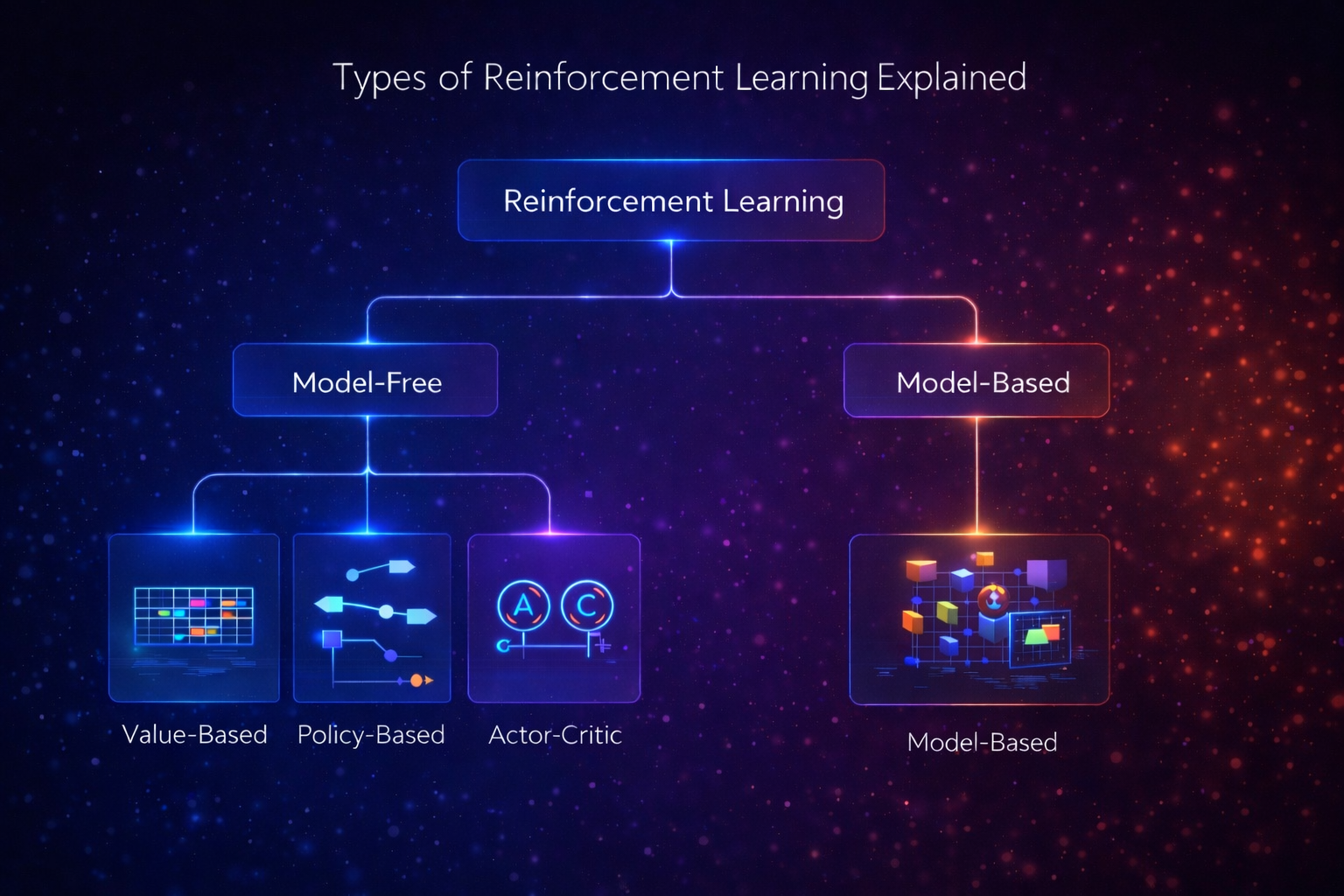
RL can be categorized in different ways.
Model-Free vs Model-Based Learning
| Type | Description |
| Model-Free | Learns from trial and error without understanding the environment |
| Model-Based | Builds a model of the environment to plan actions |
Value-Based vs Policy-Based Methods
| Type | Description |
| Value-Based | Focuses on estimating the value of actions (e.g., Q-learning) |
| Policy-Based | Directly learns the best strategy (policy) |
| Actor-Critic | Combines both approaches |
Real-World Applications of Reinforcement Learning
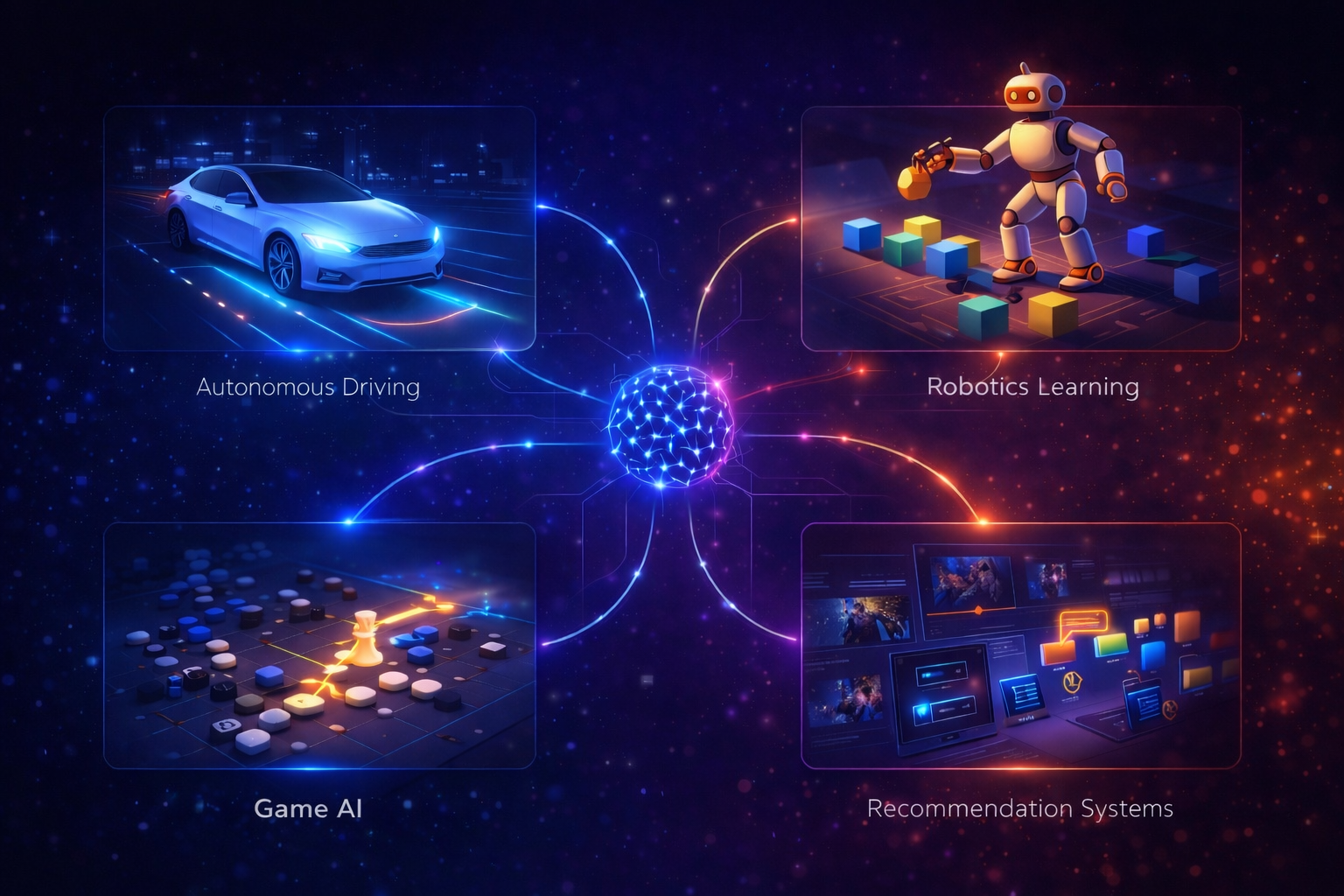
RL is used in many advanced AI systems.
Gaming
RL has powered AI systems that beat human champions in games like:
- Chess
- Go
- Video games (e.g., Atari, Dota 2)
Robotics
Robots learn tasks like:
- Walking
- Grasping objects
- Navigating environments
Self-Driving Cars
RL helps optimize:
- Driving decisions
- Route planning
- Safety behaviors
Recommendation Systems
Platforms like Netflix or YouTube use RL to:
- Improve content suggestions
- Maximize user engagement
Finance
Used for:
- Algorithmic trading
- Portfolio optimization
👉 See more: Real-World Applications of AI
Advantages of Reinforcement Learning
Learns Without Labeled Data
No need for pre-labeled datasets like in supervised learning.
Adapts to Changing Environments
Can continuously improve over time.
Handles Complex Decision-Making
Useful for multi-step problems with long-term rewards
Human-Like Learning Approach
Mimics how humans learn through trial and error.
Limitations of Reinforcement Learning
Requires Large Amounts of Training
Learning can take a long time.
Reward Design Is Difficult
Poor reward design can lead to unintended behaviors.
Exploration Can Be Risky
Trying new actions may lead to bad outcomes.
High Computational Cost
Training RL models can be expensive.
Reinforcement Learning vs Other Types of Machine Learning
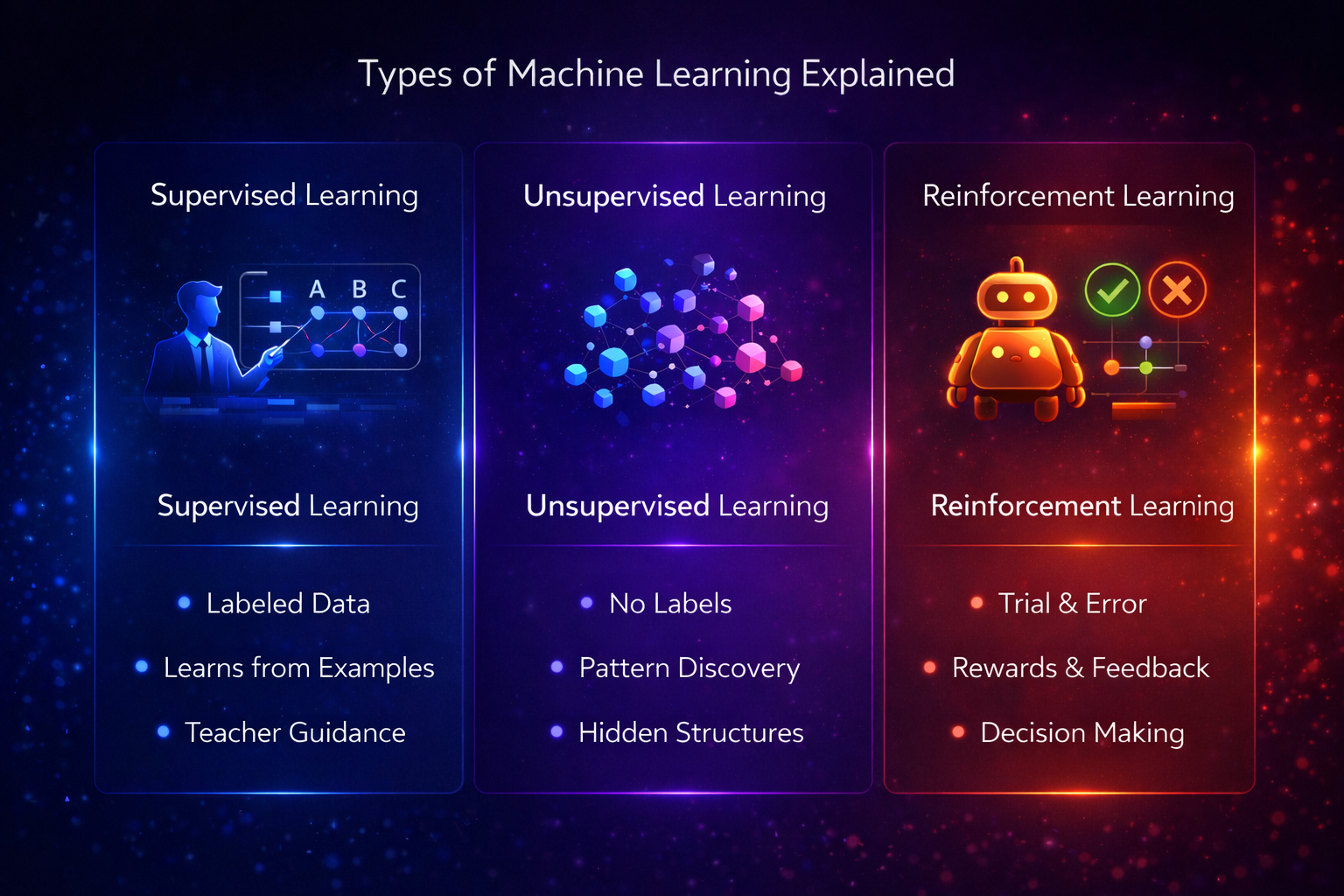
| Feature | Reinforcement Learning | Supervised Learning | Unsupervised Learning |
| Data Type | No labeled data | Labeled data | Unlabeled data |
| Learning Style | Trial and error | Learn from examples | Find patterns |
| Feedback | Reward signals | Correct answers | No direct feedback |
| Use Case | Decision-making | Prediction | Clustering |
👉 Learn more:
How Reinforcement Learning Connects to Deep Learning
RL often combines with deep learning to create Deep Reinforcement Learning.
This allows systems to:
- Handle complex data (images, video, text)
- Learn directly from raw inputs
Example:
- AlphaGo used deep RL to defeat world champions.
👉 Related: Deep Learning Explained
👉 Related: Neural Networks Explained
Future of Reinforcement Learning

RL is a rapidly evolving field with exciting future potential.
Smarter Robotics
More capable robots in homes and industries.
Autonomous Systems
Improved self-driving cars and drones.
Personalized AI Systems
Better recommendations and adaptive user experiences.
AI Agents and Automation
RL will play a key role in:
- AI assistants
- Autonomous decision-making systems
Frequently Asked Questions (FAQ)
1. What is reinforcement learning in simple terms?
It’s a way for AI to learn by trying actions and getting rewards or penalties.
2. How is reinforcement learning different from supervised learning?
Supervised learning uses labeled data, while reinforcement learning learns through trial and error.
3. What is an example of reinforcement learning?
Training a robot to walk or an AI learning to play a video game.
4. What is a reward in reinforcement learning?
A signal that tells the AI whether an action was good or bad.
5. What is a policy in reinforcement learning?
A strategy that determines what action the agent should take.
6. What is deep reinforcement learning?
A combination of reinforcement learning and deep learning for complex tasks
7. Is reinforcement learning used in real life?
Yes, in robotics, gaming, finance, and recommendation systems.
8. Why is reinforcement learning difficult?
It requires lots of training data, computing power, and careful reward design.
9. Can reinforcement learning work without human input?
Yes, it can learn from interactions with the environment.
10. What industries use reinforcement learning?
Gaming, healthcare, finance, transportation, and more.
External Resources for Further Learning
Conclusion
Reinforcement learning is a powerful and unique approach to machine learning that focuses on learning through experience. By interacting with environments and receiving feedback, AI systems can improve their decision-making over time.
While it comes with challenges like high computational cost and complex reward design, its potential is enormous—especially in robotics, autonomous systems, and advanced AI agents.
As AI continues to evolve, reinforcement learning will play a key role in building smarter, more adaptive systems.
Recommended Next Articles
To continue learning, explore:
Ciao, volevo sapere il tuo prezzo.
Hello,
My price on what?