
Artificial intelligence, machine learning, and deep learning are related, but they are not interchangeable. Artificial intelligence is the broad field. Machine learning is one major approach within AI. Deep learning is one approach within machine learning.
That hierarchy matters because not every AI system learns from data, and not every machine-learning system uses deep neural networks.
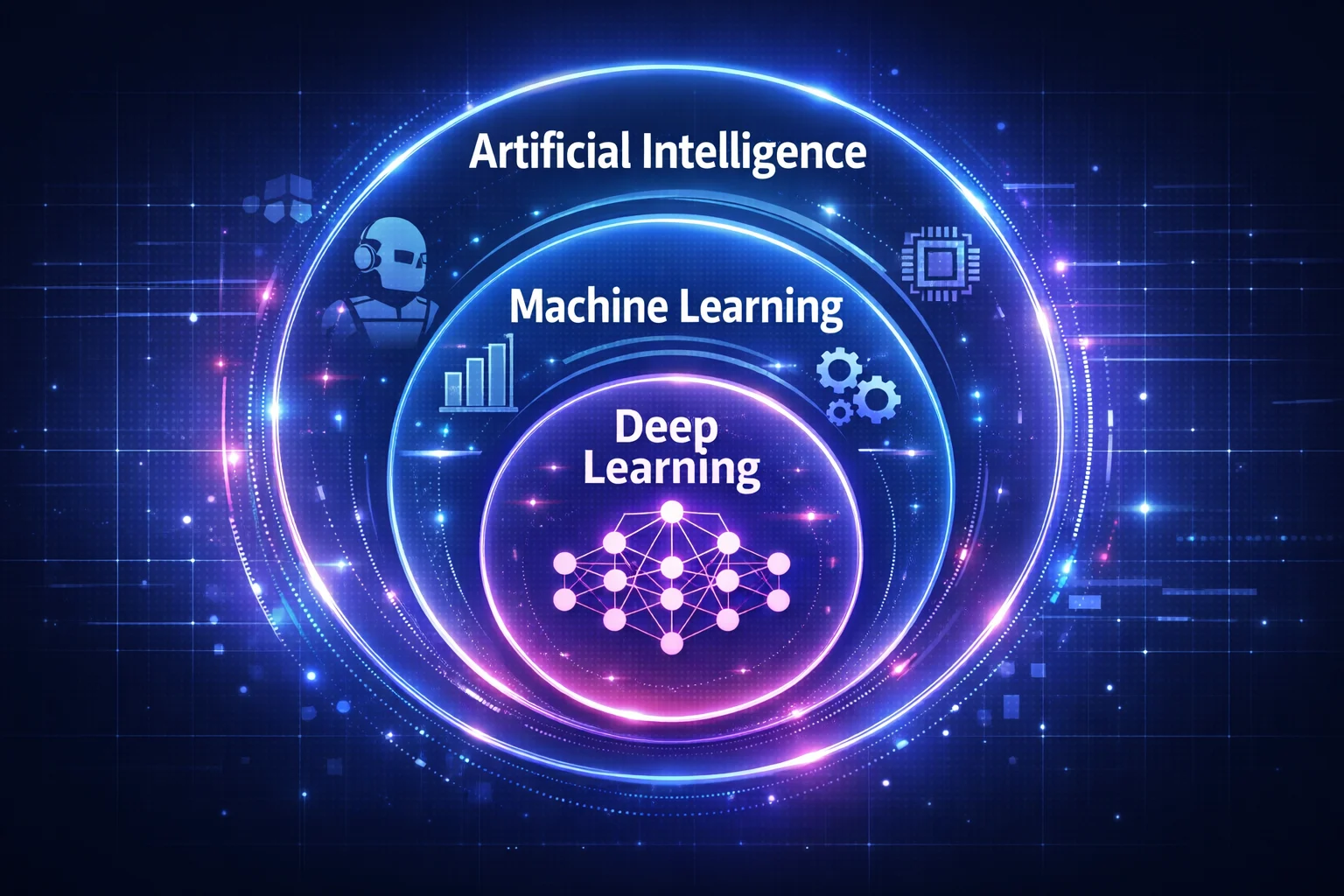
The relationship at a glance
Swipe horizontally to view the full comparison.
| Term | Scope | How it works | Examples |
|---|---|---|---|
| Artificial intelligence | Broadest category | May combine rules, search, planning, optimization, machine learning, software, and human oversight. | Expert systems, planning tools, ML applications, generative-AI systems |
| Machine learning | Subset of AI | Fits models to data so they can classify, predict, rank, cluster, or select actions. | Linear models, decision trees, random forests, KNN, neural networks |
| Deep learning | Subset of ML | Uses multilayer neural networks to learn representations and task-relevant patterns. | Transformers, convolutional networks, deep speech and vision models |
What is artificial intelligence?
Artificial intelligence is the umbrella field. It includes systems designed to perform tasks that people associate with intelligence, such as interpreting language, recognizing objects, planning routes, recommending actions, or generating content.
Some AI systems use machine learning. Others rely mainly on explicit rules, search, symbolic reasoning, mathematical optimization, or hybrid approaches. A rule-based expert system can therefore be AI even if it never learns statistical patterns from data. This broad framing is consistent with NIST’s AI terminology, which does not define AI as machine learning alone.
For the complete foundation, read What Is Artificial Intelligence?
What is machine learning?
Machine learning is a subset of AI focused on systems that estimate patterns from data. Developers choose a task, learning objective, data, model family, and evaluation method. Training adjusts the model; deployment uses the fitted model to make predictions or support decisions.
Machine-learning methods include linear and logistic regression, decision trees, random forests, support-vector machines, nearest-neighbor methods, clustering algorithms, and neural networks. They can support supervised, unsupervised, reinforcement, self-supervised, and other learning settings.
A model does not automatically improve merely because time passes. Improvement requires new evidence, retraining or adaptation, validation, and controlled deployment. Continue with Machine Learning Explained or compare the Types of Machine Learning.
What is deep learning?
Deep learning is a machine-learning approach based on neural networks with multiple layers. These models can learn internal representations from text, images, audio, video, sensor readings, and other inputs.
Modern deep-learning architectures include convolutional networks, recurrent networks, transformers, and autoencoders. Diffusion models are a generative modeling approach that commonly uses deep neural networks. These approaches support many language, vision, speech, and generative-AI applications.
“Deep” describes the network’s layered computational structure. It does not mean the system thinks like a human brain, understands every output, or is automatically better than a simpler method. Neural networks are a family of machine-learning models; not every neural network is a deep neural network. Deep learning refers specifically to sufficiently deep, multilayer neural-network approaches. See What Is Deep Learning? and Neural Networks Explained.
AI vs machine learning
The difference is scope. AI is the larger field and system goal; machine learning is one group of techniques used to build some AI capabilities. An AI product can combine a learned model with rules, retrieval, search, databases, user interfaces, monitoring, and human review.
Machine learning vs deep learning
Deep learning is not a competing field beside machine learning. It is one part of machine learning. Classical or non-deep ML methods include approaches such as linear models, decision trees, random forests, support-vector machines, and nearest-neighbor methods.
Deep learning uses deep neural networks and is often valuable when learned representations from complex inputs matter. For the practical comparison—including data, compute, interpretability, and model-selection tradeoffs—read the focused Deep Learning vs Machine Learning guide.
Choosing an approach
Begin with the problem and a credible baseline. Classical or non-deep ML may suit structured problems or constraints such as cost, latency, and interpretability. Deep learning may suit complex inputs when representation learning or pretrained deep models offer value. Validate the choice empirically; no category is universally more accurate or powerful.
Three common misconceptions
AI and machine learning mean the same thing
They do not. AI is the broader field; machine learning is one group of methods used within it. Some AI systems use rules, search, planning, optimization, or hybrid approaches without learning a model from data.
Machine learning and deep learning are competing technologies
Deep learning is part of machine learning. Classical or non-deep ML methods and deep neural networks are different approaches within the same broader family, and they can also be combined.
Generative AI means all AI
Generative AI is one part of the broader AI landscape. Most leading modern generative systems use deep learning, but generative AI is not synonymous with all AI, all machine learning, or all deep learning.
Sources and further reading
- Google for Developers: What is machine learning?
- Google Machine Learning Crash Course: Neural networks
- IBM: What is artificial intelligence?
- NIST AI Risk Management Framework: Glossary
Where to learn next
Continue into the first major AI method, or return to the broader foundation if you are starting from the beginning.